argus-cortex
Shared foundation: taxonomy, versioned wire-schema tooling, and the local/remote AI backend contract.
Theo Menne · Remote · Australia
Dragonhound Labs is where I publish the Argus suite: 9 packages on PyPI that take images from public-domain and CC0 sources through curation, captioning, LoRA training configs and evaluation. Each package works on its own; they share one taxonomy, wire schema and backend contract in argus-cortex.
A training-data pipeline, one package per stage, over a shared foundation.
argus-cortexShared foundation: taxonomy, versioned wire-schema tooling, and the local/remote AI backend contract.
argus-quarryProvenance-first acquisition of public-domain / CC0 portrait images: the input stage of the suite.
argus-curatorDataset curation for LoRA training: quality filtering, embedding-based diversity clustering, and subset selection.
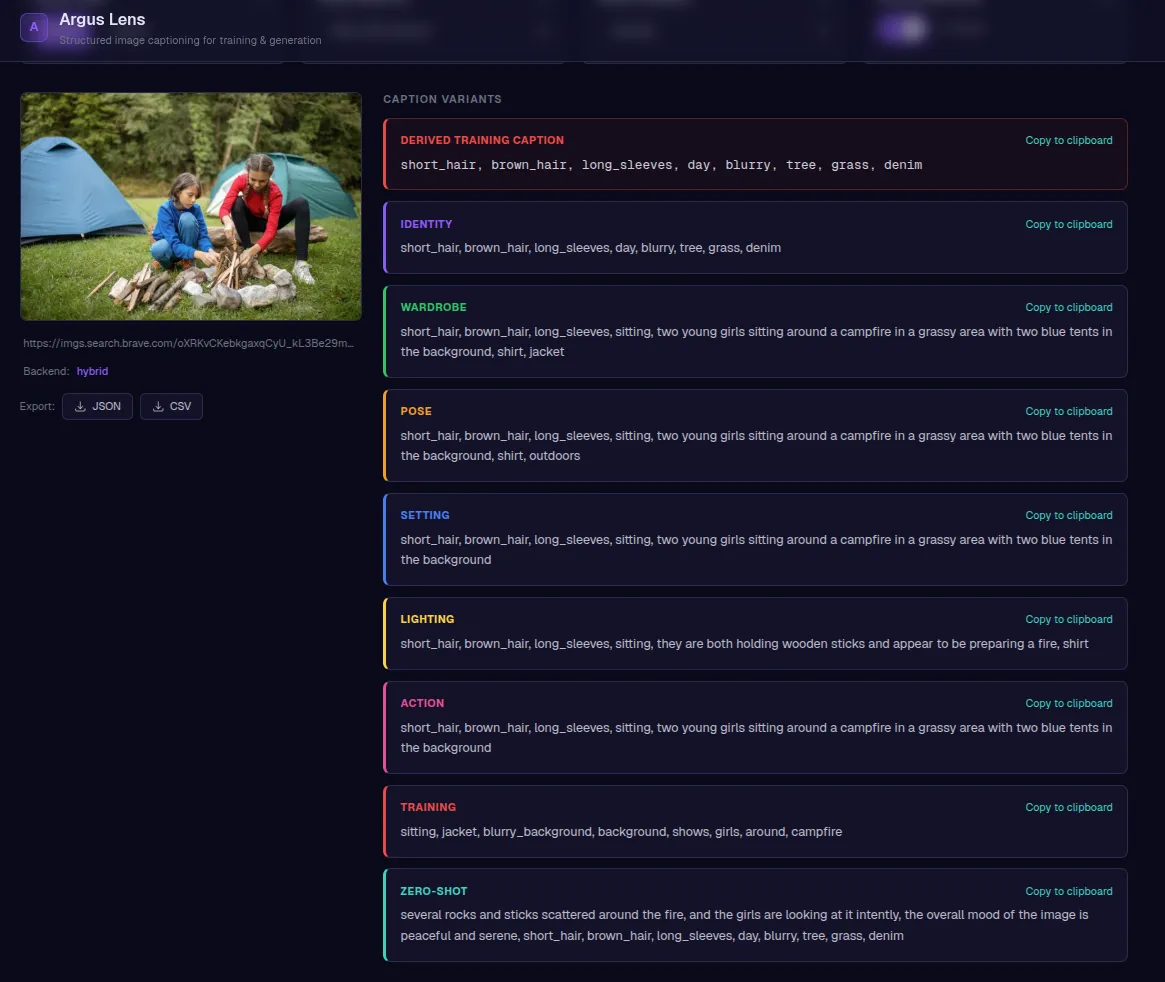
argus-lensStructured image captioning for training and generation.
PyPI 0.10.0 GitHub Demo: Lightbox (coming soon)
argus-forgeTurns curated dataset exports into ready-to-run LoRA training configs (kohya_ss / OneTrainer / diffusers).
argus-proofPost-training LoRA evaluation: generate samples from a trained LoRA and score them against the dataset it was trained from.
argus-atlasBakes georeferenced fantasy-map overlay tiles from real terrain: GDAL controls from a DEM, restyled through a cartography LoRA, stamped back to GeoTIFF and PMTiles.
PyPI 0.3.0a1 GitHub Demo: Realms (coming soon)
argus-darkroomGuarded image generation: prompts and outputs are checked before anything is released.
PyPI 0.1.3 GitHub Demo: Safelight (coming soon)
argus-mintProvenance tokens for game assets: reviewed-template renders, IPFS pinning, ERC-721 cards, soulbound deeds and on-chain Merkle anchors (Base).
PyPI 0.2.0 GitHub Demo: Assay (coming soon)
argus-surveyPoint-cloud deliverables for land surveyors (QA, ground, DTM/DSM, contours, volumes, ASPRS accuracy) with every datum and command recorded. Not yet on PyPI.
Not on PyPI yet GitHub Demo: Sightline (coming soon)
argus-maskA talking face for the suite: audio in, facial animation frames out, rendered in a browser on any screen on the LAN. Not yet on PyPI.
Not on PyPI yet GitHub
Each demo exists to show one package doing one thing. Demos run on recorded output, so no model or GPU runs while you browse.
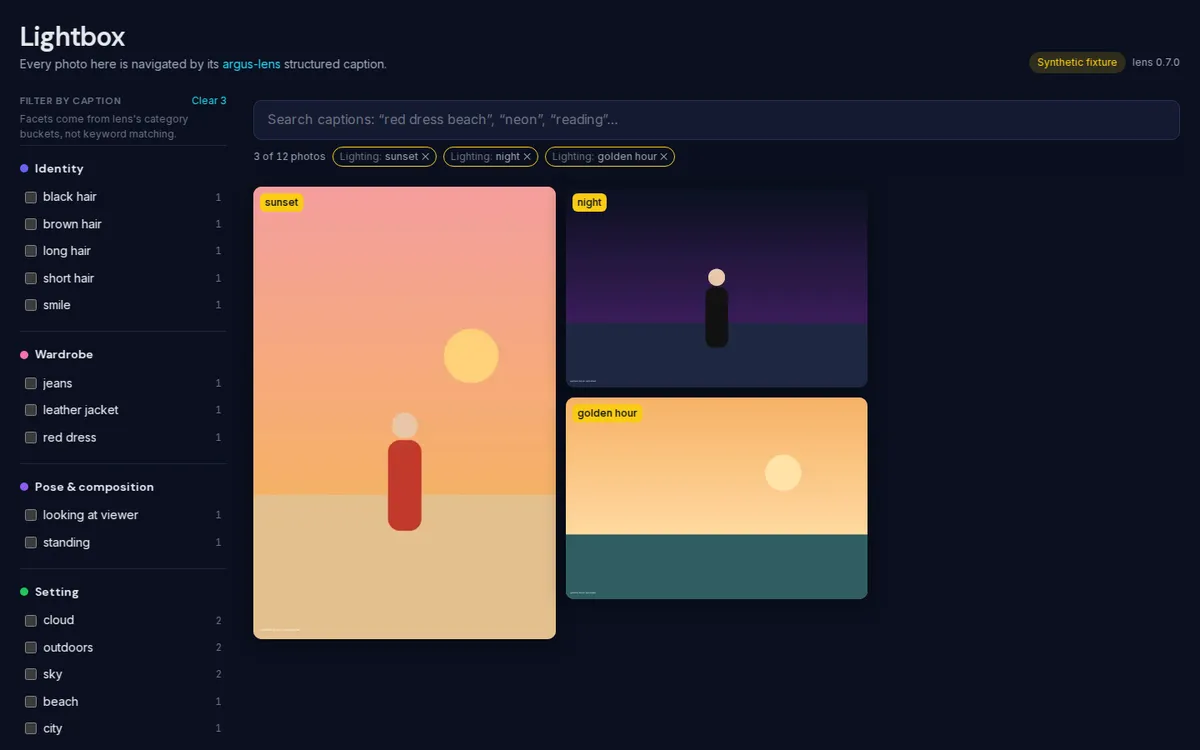
What it proves. argus-lens captions are structured data, not one flat string. The gallery filters by lens's category buckets (wardrobe, lighting, setting), and shows how each caption was assembled from the raw model output. Fully static: a bake step re-runs lens's caption assembly on CPU, no model or server at view time.
Coming soon
What it proves. The packages run together as one Docker Compose stack from published GHCR images: curate, caption and export LoRA training datasets from a single web UI, with each parameter explained inline.
Coming soon Source
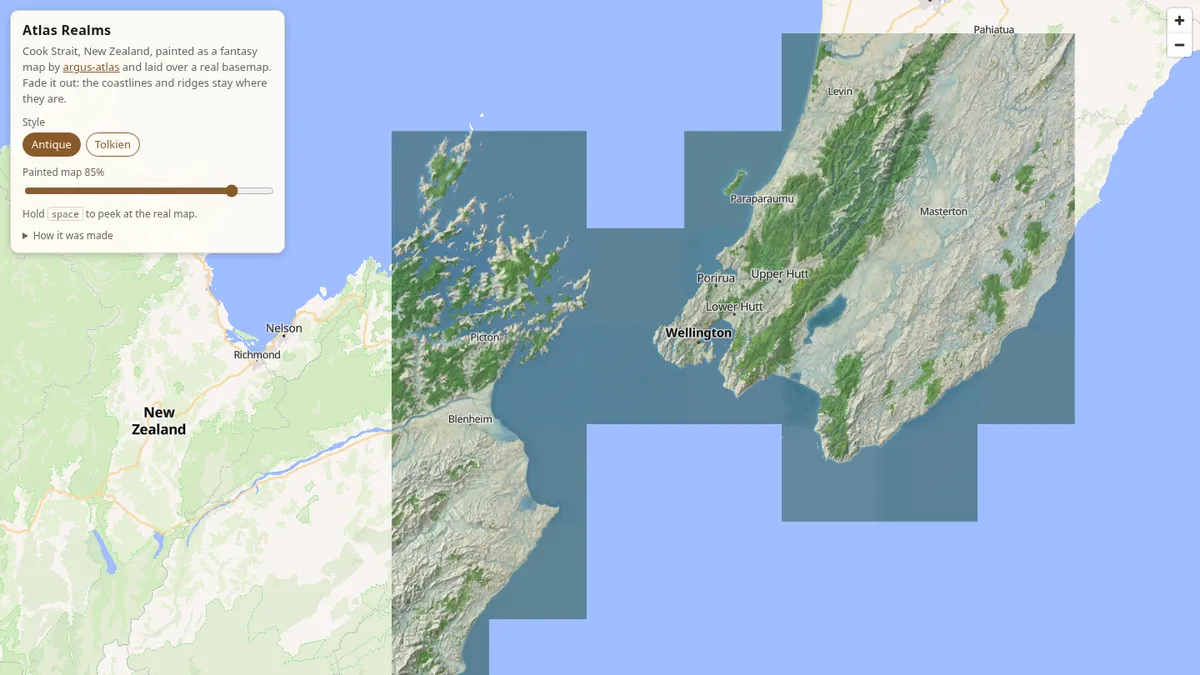
What it proves. Cook Strait, New Zealand, painted as a fantasy map by argus-atlas and laid over a real basemap. Fade the painted layer and the coastlines and ridges stay put.
Coming soon argus-atlas
The same release and CI rules across every repo, kept in code rather than in a checklist.
Reusable GitHub Actions workflows: one definition of the uv + ruff + pytest + build pipeline. Eight of the nine published packages call it, so lint and test rules don't drift between repos.
A Copier template for new suite packages: uv tooling, hatch-vcs versions from git tags, src/ layout, typed, wired to argus-ci. Running copier update pushes convention changes into existing repos.
Releases go to PyPI over OIDC trusted publishing on version tags, with no long-lived API tokens. All nine published packages release this way.
Terraform (HCP state) + Cloudflare DNS/R2 for the public demo stack, with a public/private host split and no public data ports.
From my time at Komodo: video walkthroughs, API documentation, and a Python client.
 Launch your own blockchain in less than 15 minutes!
 Setting up an ElectrumX Server
 PytomicDEX Makerbot User Guide
All videos on YouTube (@dragonhound7227)
Owned the public API docs at Komodo: MDX built in CI, with Postman-generated request examples in several languages.
Python client for the Komodo DeFi Framework API, on PyPI (0.2.6).
Theo Menne. GIS work first, then support, QA and quality leadership at Komodo Platform, now open-source Python libraries. Remote since 2018.
Python and GDAL/OGR geoprocessing over enterprise geodatabases. Designed and ran QGIS training for postgraduate scientists and staff (2012–2019).
Support Agent (2018–19), then QA Lead (2019–22).
Owned the public API docs and CI across Python, Rust, Go, C++ and MDX repos. Reviewed changes and shipped fixes on the public wallet repos. Built async FastAPI services (WebSocket, CRUD, proxy APIs). Published pykomodefi.
Publishing the Argus suite: nine packages on PyPI on a shared contract.